
INTERVIEW CONTINUED FROM PREVIOUS PAGE
Josh Lurie: What was your first cocktail memory?
Christy Pope: I have several kind of along the way that are integral memories. One of my first memories was the first time I went to Milk & Honey. I was living on the Lower East Side. I lived in Chinatown, and Milk & Honey is on Eldridge Street, which is on the Lower East Side, and I’d walk down Eldridge Street to get to my apartment. This is right when Milk & Honey first started opening, and that was a pretty desolate street. There wasn’t a whole lot going on Eldridge. If you go there now, Lower East Side is hugely popular, and there’s a ton of establishments, but at the time, Milk & Honey was a lone solider. Obviously, it being a more hidden destination at that. My roommate at the time, he was a musician and worked in the same area, he had been in a couple times and kept telling me about this place and he took me, and he very secretly stuck me around the corner and he made the call and I walk into Milk & Honey for the first time, and we had very simple drinks. I had a Moscow Mule, and he had a tequila and grapefruit, and the Moscow Mule blew me away with the fresh ginger. That was the first time I ever had a real fresh ginger drink, you know, where Sasha squeezes the ginger. And the tequila and grapefruit was astounding. It was the first time that someone had squeezed real fresh grapefruit. Something as simple as tequila and grapefruit was life changing. None of my bar experiences up to that point had paralleled the beautiful simplicity that was in front of me. I was just sitting there talking, and the whole feel and vibe of the place was really great. Sasha was talking about how it was getting busier and he’d have to find somebody for the floor and I was like – I was doing other things in my life, I was a DJ and never thought about working in a bar – but that moment of being wrapped up in those drinks and being in good company – really feeling that vibe – I was like, I’ll do it, I’ll be your floorperson. That’s how I got involved in the Milk & Honey family.
The next integral cocktail moment for me was, I took a class with Dale DeGroff at the Culinary Institute, and he took us through a tasting, a three night course, 12 cocktails. The one that really struck me was the Blood and Sand, just the idea of sweet vermouth, Cherry Herring, Scotch and orange juice working together in that way, and being so delicious, that just opened so many doors in my mind. And then as I got more integrated into the work I was doing at Milk & Honey and seeing what everybody was doing when I started wanting to participate by doing all the things bartenders were doing behind the bar, that story of the Casino, where I was taking my own time and researching the history and lore of different drinks, and finding this recipe that I thought looked really good and I was working with Joseph, playing around with it, and just finding this perfect balance for it and giving it to someone and that person being so genuinely thrilled that I had given them something they never had before kind of opened a door. That was the moment that I thought, I can go this path.
Chad Solomon: For me, it would be what I said before, being served the Silver Lining, the texture of the egg white, the glass with the big piece of ice, Joseph and his suspenders and his arm garters, it was an encapsulating experience. Especially in New York in those days, you had bottle service culture was waning at the end. You already had the tech crash, but bottle service had been the big thing at the end of the ’90s. The Meatpacking District was not even really on the map yet. There was nothing really over there other than Florent. The old Sex Club had closed, and Pastis was there. It was still like the red velvet days with doormen. Who are you? Are you on the list? Milk & Honey was a very radical, 180-degree counterpart to that. There was a democracy at the door. If you can behave yourself in an adult like manner, then you’re welcome here. I don’t care who you are. The idea of the bar wasn’t built on cocktails, it was built on intelligent conversation, with good company. The totality of that environment was without a doubt memorable.
JL: Who are some other bartenders that you think are especially notable or inspiring?
CP: There are a lot of them out there today. For me, obviously my personal mentors are Sasha Petraske, Joseph Schwartz, Audrey Saunders. I’ll include Chad. Even though we’ve been working together along the way, he’s very much a mentor in that we bat off of each other all the time. As far as looking as people in the industry, I love seeing what Eric has done here at The Varnish. I’m so thrilled to be working with Marcos Tello. He’s really done so much for the L.A. scene out here. What’s Richie’s doing at Dutch Kills is awesome. Having worked with Ryan Magarian, I really appreciate the work that he’s done on a consulting level. I know I’m forgetting people, but off the top of my head.
CS: It’s been interesting, because the entire first wave of bartenders who inhabited Milk & Honey in the beginning, and the entire opening staff at Pegu, if you look at everybody – with the exception of Wilder and Elizabeth, who have gone on to successful music careers – everybody else has stayed in the business and they’ve all grown. From the opening crew at Pegu, everybody is doing really amazing work. They’re all fantastic bartenders. Other people who aren’t part of those groups, our friend in London, Tony Conigliaro, is somebody who is incredibly fascinating. His creativity and the work that he’s doing is some of the most interesting, without a doubt. I think Marcos, up and coming, is really the embodiment of the consummate bartender, who embodies all of the skill sets, is a really fantastic host at the bar, and it’s been really exciting to watch him grow and to have him on board with us here. The way Richie has expanded Sasha’s bars. Joseph is somebody in particular for me and Christy, he doesn’t get a lot of credit, and he’s kind of the unsung hero, but he is Little Branch. When Sasha was away in London, opening Milk & Honey for a year-and-a-half, Joseph was the heart and soul of Milk & Honey, it went from being…
CP: He didn’t just foster me, he fostered Richie and Eric.
CS: Joseph is behind the scenes, but he’s been…
CP: Huge presence…
CS: And he doesn’t really get a lot of credit. Eric obviously for coming out here. Those are all of our friends and typical answers, but still, they’re doing great work. One thing that’s interesting on the M&H side of the family, is the way Richie has taken Dutch Kills – and it was kind of an expansion of Little Branch – is he’s really taken the Petraske model and done his own thing with it. Dutch Kills is his thing, and he’s done some great things over there.
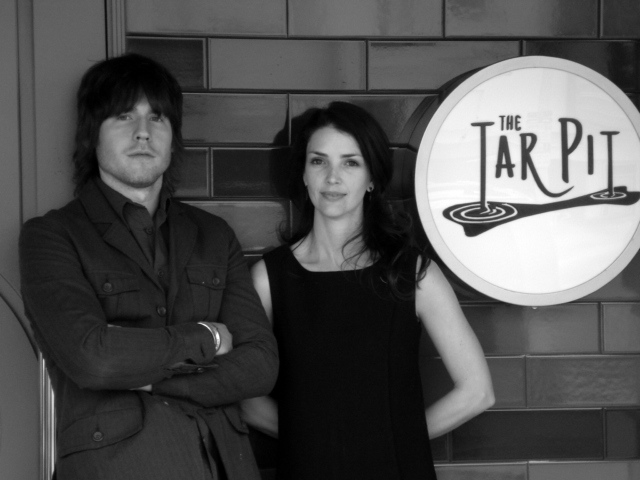
CP: It’s interesting to watch people collaborate. Richie and Giuseppe have collaborated well. The whole thing about this is finding your best partners to collaborate with. That’s what’s been fun about this. Me, Chad and Audrey to collaborate on this level to tweak out The Tar Pit.
CS: Ryan Magarian, also, we worked with him and his approach to consulting, the amount of detail and the thought that he has put in, it’s so much deeper than, okay, we’re going to go teach you these recipes. Or I’m going to create this menu for you. I don’t know another consultant, of all the consultants we have worked with, who approaches it in the same way that he does. We really benefited by spending three years with him thinking about just the way you go in and teach somebody, and get them motivated to inspire them. He does some really amazing work. His influence is really important in L.A. because of what he did with SBE. Those are bars that are 180-degrees different from the cocktail houses that we come from, very different clientele, and yet he’s taking craft cocktails and acclimating a totally different clientele to this, which has made this better for everybody, especially with us coming in.
CP: As interestingly, not only is it a different clientele, but it’s a different caliber of bartender, in that you have bartenders – we’re lucky in that we have people who seek us out who are very interested in this craft and looking to grow and they know this is something they want to stick around in for awhile – and Ryan tends to work with bartenders who have a lot of other avenues in their life that they’re looking at, and this is something that they’re doing for the time being. When you’re working with someone that maybe this isn’t the career they want to keep forever. Maybe this isn’t the style to engage those people, and he has a very adept ability to make people do that.
JL: What do you think is a great simple recipe for people to make at home?
CS: I think the most basic things. A simple sour. A simple daiquiri. An Old Fashioned and a Manhattan. You’ve all got three-ingredient wonders there that are so simplistic, and if people haven’t had those, they’re kind of revelatory.
JL: What’s your Old Fashioned recipe?
CS: Two ounces of spirit. Generally an Old Fashioned is thought of as a whiskey drink. It can be rye whiskey. It can be Bourbon. It can be rum. It can be an aged tequila. An Old Fashioned is an incredibly versatile template to work with and fun to play around in. Cognac. Find what works for you. A very simple recipe is two ounces of spirit, a quarter ounce of a 1:1 ratio of simple syrup or a sugar cube.
CP: You can play around with the sweetener. It can be agave or honey.
CS: Instead of simple syrup, maple syrup, honey, agave nectar. You can use Demerrera syrup as opposed to a white sugar syrup. Just playing with your sweeteners is fun. A couple dashes of bitters. And then manipulating a citrus twist. Is it a lemon twist, an orange twist or a grapefruit twist? So depending on what the spirit is, it’s kind of a Rubik’s Cube of constantly turning it and seeing. We’ve exploited that. We’re always plugging things into that. Even though it’s a spirituous drink when it’s made and balanced out, we’re big fans of measuring. It’s so simple to do. Measure your ingredients. Stir and you end up with the right amount of dilution, even though it’s a spirituous drink, most people find that palatable.
JL: If you could only drink one more cocktail, what would it be?
CP: “What’s your favorite cocktail?” I must get asked that question five times in one night. It’s impossible to say one cocktail. Even if I was given that choice right at this moment, if you could only have one more for the rest of your life, it’s such an of-the-moment decision. It’s just where you are that day. Do you want something soft and silky with an egg white? Are you in the mood for something citrusy? Do you want something stirred and strong? It’s kind of where you’re at, what you’re feeling, what your needs are for that moment, and your favorite cocktail in that moment is always going to be different.
CS: My regular answer is, and this is kind of cheeky, it’s the one in my hand. Where am I and what am I doing? It would be very tough choosing between an Old Fashioned and a daiquiri. An Old Fashioned and a daiquiri are simple drinks, but both are delicious in their own right.


Blog Comments
Food GPS » Q&A with bartenders Christy Pope and Chad Solomon (The … | chad News Station
February 12, 2010 at 12:58 PM
[…] here: Food GPS » Q&A with bartenders Christy Pope and Chad Solomon (The … Share and […]
Diana
February 12, 2010 at 9:40 AM
I love that Chad says a daiquiri is his favorite cocktail! I think that’s actually the first cocktail I had — my dad would make virgin ones for my brothers and me, and liquored ups ones for my mom and him. Good stuff. I always liked the peach ones best.