
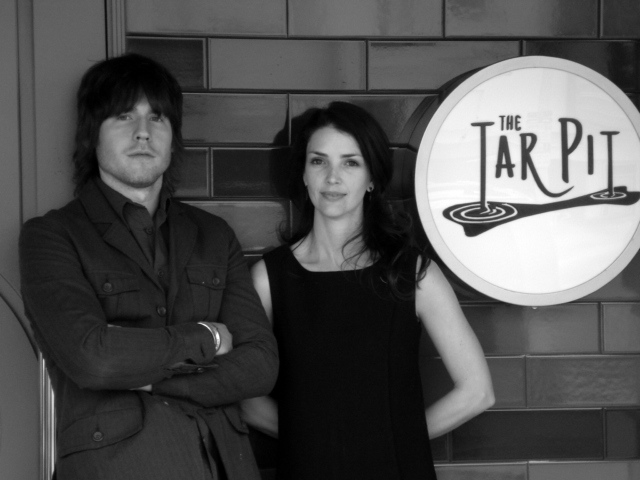
The world is flat. Thomas L. Friedman’s metaphor for the global economy also applies to the cocktail world. Increased communication channels, the rise of the internet and guest bartending stints have led to unprecedented exchange of ideas. At the forefront of the movement are bartenders like Christy Pope and Chad Solomon, who rose through Manhattan’s ranks before relocating to Los Angeles to help Audrey Saunders, chef Mark Peel and GM Jay Perrin launch The Tar Pit. The duo recently joined me at their Art Moderne cocktail palace to discuss the transition.
Josh Lurie: How did you familiarize yourself with the L.A. scene?
Christy Pope: We’ve been out here various times over the years for consulting projects, so we had a pretty good idea for the landscape, cocktail wise. We’re very familiar with Eric [Alperin], who we worked with in the past. He’s doing The Varnish. We obviously know about Cedd’s places, and Marcos [Tello], with what he’s done with The Sporting Life. We know about Copa d’Oro and Vincenzo [Marianella] and all the various things that are going on. So we were pretty familiar with the landscape. It seems like an exciting time to be here.
Chad Solomon: Christy and I also came out here a couple years ago, when we did a project with Hennessy. We did numerous stops around the country. We came here and already knew Marcos at that point, but started to meet some of the other players. Also, Sammy Ross had come out from New York and done Comme Ca, and we were here during that opening, so we knew all the Comme Ca bartenders from that original crew. We met all the Seven Grand guys. We met Damian Windsor at the Hennessy event. And after Marcos really started to organize The Sporting Life, every year, we saw all of those guys in New Orleans. Between those elements and coming out here and checking in with everybody, we’ve had standing relationships with everybody and knew these bars.
JL: What’s the difference between the L.A. and New York cocktail scenes?
CS: The only difference between here and back east is that New York has had a longer time to grow. What’s interesting about L.A. is that in the span of two years, it’s grown at lightning speed. The existing players are here. The next layer of expansion with cocktail bars is going to be, in short order, saturated in terms of the volume of bars.
JL: Are there elements from the New York cocktail culture that you’d like to see here, that don’t exist yet, or that you’re bringing?
CS: We have our approach to cocktails, but L.A. has taken on a bit more of the New York technique when it comes to cocktail making, much more than the San Francisco influence. San Francisco and New York, ten years ago, were two very different animals. Because of communication, relationships, because of the internet, that line has been blurred to the point that there isn’t that big of a difference…Creatively, we’re looking to play with other spirits, and give them more attention. We’re always looking to push ourselves into creating new flavor profiles. On the other side, our focus is changing the guest experience. It’s been so much that the experience is academic, the cocktail’s being worshipped, the bartender’s become deified, and not necessarily in a good direction, so we kind of want to let the air out of the tires a little bit and be like, hey, this is cocktails, this is fun.
CP: One thing that L.A. has historically on the cocktail scene is the Hollywood element…You look at the ’30s and ’40s, there’s a lot going on here in L.A. with cocktails, and that feeling of glam, that beautiful ode to Hollywood, is something that’s really inherent here, and something that helped us influence the way we wanted to The Tar Pit to feel and be, which was kind of this throwback to the supper club, Hollywood glamour, having Bogie and Bacall, or Bette Davis, at your bar. There was just that certain element of glam that greatly influenced cocktails. We want to help revive what was naturally inherent in cocktails from that era.
CS: At the same time, L.A., after Prohibition, was ground zero for tiki.
CP: Very true.
CS: Don the Beachcomber opened here in Hollywood. That was a totally different take on bars and cocktails. There was a whole new fun element that is inherent here.
JL: How did the two of you become so interested in cocktails?
CP: I’d been working at Milk & Honey. I got hired the Thursday before 9/11. Because of the way that downtown was after that event, it was very slow, so I needed to not only work at Milk & Honey. I applied for The Cellar Bar, and that’s where I met Chad. We would talk when we were working, and started telling him about Milk & Honey. He started visiting and saw what we were doing at Milk & Honey. This was the first year that it was open. We were all getting a feel for this thing called the cocktail. People like Dale [DeGroff] would come in and tell stories. You’d want to go home and read about that, so we started going back in history. For me, it was all about finding the back story to certain liquors and certain cocktails, being around people like Dale, and someone like Ted Haigh coming into the bar, hearing that there’s this great pre-story to this thing called the cocktail that I hadn’t known much about…All of us who worked there started egging each other on…We all kind of organically grew together in that sense. Being really wrapped up in the history and taking charge to learn more about it is what really interested me in cocktails. Obviously there’s the artistic element of mixing drinks, understanding balance and flavor, what a certain spirit brings against another, and all that. I would say, for me, my general interest in cocktails started from a historic angle.
CS: For me, bartending was a sheer accident. Before 9/11, I had been working in film production in the city for two years. 9/11 happened and they stopped filming indefinitely at that point. A buddy of mine said, “Hey, you should jump behind a bar in the interim, until production starts up again.” He told me about this place called Milk & Honey, which was already an urban legend. It’s a secret bar that stays open until the last guest leaves. He mentioned, if you get a job there, there are rules, and it’s very particular, but if you work there, you’ll learn how to make these amazing cocktails…Sasha didn’t need anybody at that point…The Bryant Park Hotel had just opened, and it was the new boutique hotel. Christy and I interviewed on the same day. In the next couple weeks, we had a shift together and started talking. What else do you do? I work at this place called Milk & Honey. I told her about my experience there. Shortly after that we started dating. She took me into Milk & Honey and I went and sat at the bar. Joseph Schwartz was bartending and he made me a Silver Lining, which is his drink. It wasn’t like a light bulb going on, it was like being struck by lightning. To watch Joseph work, he was very purposeful…He was very detail oriented, and his drink tasted like nothing I had before. I had been bartending for a couple months, and the question was, “Why is he doing this, and I’m not doing this? How do I get my drinks to taste like that?” It just started the questions…We had access to all this stuff at the Bryant Park, and all of eau de vie on the back bar, the entire Marie Brassard line, things that you didn’t see. Prior to that, I liked to drink gin, I liked to drink whiskey, I liked to drink tequila, but not in cocktails.
Shortly after that, we met Dale. Dale opened the door in a number of ways in the interest level. The history and back story got me hooked, line and sinker. I just wanted to learn more, and when I communicated like that with people, and they responded to it, responded in such a positive manner. There was this visceral connection to what you were drinking because of this back story, it inspired me to want to learn more, so you could communicate that. We really dove in and sought out Gary [Regan] and Ted [Haigh] and Robert Hess, and we met all these guys early on and developed good friendships with these people and were able to be mentored along the way. We met Audrey, and Sasha was a great teacher. We were in the right place at the right time and kept feeding this interest. It kind of compounded in the perfect manner.
CP: I tell everybody that I learned to bartend backwards. Most people in a bartending career have worked in various, numerous places, and the first things that they learn to make are a kamikaze or a Cosmo, or a lemon drop, whatever that might be. The first cocktails that I learned were flips or cobblers. It was six years into my career before I ever made a Cosmo because the types of drinks that we were making at Milk & Honey were those early cocktails that the whole industry was founded on. A very intrical point to me was after being at Milk & Honey and soaking in the culture and absorbing what that was about, and taking the time when I went home to read more and learn more and order vintage books on line, and things like that. I remember the first time I was working on the floor, I had come to this old book called “Just Cocktails,” this beautiful book we found online, and we started looking through all these old recipes, and a lot of recipes none of us knew. I would go in, and me and Joseph happened to generally work together. Me and Joseph would make different ones, and I remember this one called a Casino, and it just looked so good, and we made it. It was so delightful. Then I gave it to a guest, and they just went bananas. It was like the most rewarding feeling to know that something I researched and looked after and thought looked good – and then Joseph and I played around, because sometimes with those older recipes you have to tweak them a little bit, they’re written in ways that don’t translate to today, so we tweaked it out – and to have that person be so genuinely happy over something that you helped deliver them, it’s just a rewarding experience. It just feeds you to continue on that path.
JL: Would you consider yourselves bartenders or mixologists?
CP/CS: Bartenders.
JL: How come?
CS: I guess you could say mixology is a component of a bartender’s job. There are certain people – and this is an argument that’s never going to stop – part of our problem with the word mixologist, is that there’s an entitlement, and right now there’s no established standards. Anyone can call themselves a mixologist, and it’s kind of hollow. There are bartenders who practice different levels of mixology, but being a bartender is an all-encompassing job. There are a number of hats that you have to wear, and tasks and skill sets that you have to juggle as a bartender. I guess if you’re just a bartender and just creating drinks, and just doing trainings, then mixologist consultant/consulting mixologist kind of makes sense. I think bartender is a fine moniker that we’re proud.
CP: I think bartender encompasses everything that the trade and the craft is. Being the ultimate bartender is a very lofty goal. If you look at the people who are consummate bartenders, they have great personalities, they put people at ease, they’re adept physically at what they’re doing behind the bar, they’re adept mentally with the choices that they make when they give people drinks, they’re adept at being able to mix with skill and ease, and they do it with a smile on their face. If you look at bartending as a trade and a craft, then I just think bartender encompasses the whole aspect of what you really want to be able to deliver.
JL: What was the process like collaborating on the cocktail menu at The Tar Pit?
CS: First of all, Christy and I have been working together going on nine years now. We met Audrey in early 2005. We knew who Audrey was. We were very familiar with her. We met her one night at Milk & Honey, and I happened to luck out and be hired at the Flatiron Lounge, to get on deck to be on the opening crew at Pegu. So this all started back then. Audrey and I started to forge a professional relationship, a creative relationship, and very strong friendship where we connected on a creative level. We understand how each other’s minds work on a creative level. That relationship has always carried through, even though I left Pegu, and we devoted each other to Cuff & Buttons consulting, that relationship has always been close and in contact, and at a certain point, after a couple years of consulting for Christy and I, and after looking around at what we wanted to do and how we wanted to move forward, we wanted to go to the next level of ownership, especially traveling around and seeing all these opportunities in different places, we had a much clearer perspective on the board of what was out there, and so we decided to sit down and partner with Audrey to move forward. So that’s how that started. Then in terms of collaborating on the menu, essentially what’s happening is two worlds coming together within this group. You have the Audrey/Pegu side, and you have the Milk & Honey side, and I happen to work in both families. Out of all the New York bars and ideologies, approach to drink making, I’d say that they’re the closest, and there are a lot of shared ideals, and so it’s a very natural fit.
To a degree, there’s a hybridization creatively, coming together, and when we get together, the Night Marcher being a perfect example of us kind of working as a group. We had a germ of an idea for a drink. We knew that we wanted to revisit tiki, but we didn’t just want to do faithful revivals of Don Beach or Trader Vic drinks. We wanted to take our own spin on it. We all agreed that we wanted to create new flavor profiles. In the post, some of those drinks were more juice heavy. We wanted to get away from the juicy juice element to be a little bit more spirituous, spicier, but we also didn’t want to limit ourselves to the South Pacific. We were interested in moving forward with flavors from Latin America, the Caribbean, from Southeast Asia, all the way through the Middle East. There are a number of tropical climates throughout the world with very interesting flavors to bring into that style of drink making. The Night Marcher, we had this idea and really just started Audrey’s Jamaican Firefly, her fresh version of a Dark and Stormy, and plugging in from there. The way we work creatively is kind of a round robin. Somebody would add something in, and then we’d all digest it as a group, and somebody else would throw something at it. How about this, or that? We have a reputation for when we go to create a drink, creating endless versions of it, to get it dialed in. It’s kind of round robin, constantly tweaking, this works, this doesn’t, and constantly making minute adjustments until it’s dialed in.
CP: Cocktail creation, and really the entire project creation, the key word for the three of us has been fun.
CS: We get together and laugh and kind of egg each other on and build upon what someone else lays down until somebody goes, you know, I think it’s there.
CP: No idea is a bad idea. The sky’s not the limit. We’re shooting for Mars. You know what I mean? There’s a funny saying that Audrey has whenever you’re tweaking out drinks, and you’re not quite sure where to go next, and you really have this far out there idea, she’s like, “Alright, do you want to push it over a cliff?” We’re always looking to push it over a cliff. Sometimes it really works, and sometimes it totally falls apart. It’s that element of playing to really make the Rubik’s Cube fit.
CS: The creative process is a lot of fun. We really enjoy it, and that’s where a lot of ideas are born from.
JL: How often do you anticipate changing the menu?
CS: We’ve always been, and continue to be, pretty set on seasonal. Since this is the opening, we will – especially now that we’ve got open – we will look to make probably more changes in a frequent manner, and keep adding until we reach a certain level – then it will change seasonally.
JL: What was your first cocktail memory?


Blog Comments
Food GPS » Q&A with bartenders Christy Pope and Chad Solomon (The … | chad News Station
February 12, 2010 at 12:58 PM
[…] here: Food GPS » Q&A with bartenders Christy Pope and Chad Solomon (The … Share and […]
Diana
February 12, 2010 at 9:40 AM
I love that Chad says a daiquiri is his favorite cocktail! I think that’s actually the first cocktail I had — my dad would make virgin ones for my brothers and me, and liquored ups ones for my mom and him. Good stuff. I always liked the peach ones best.